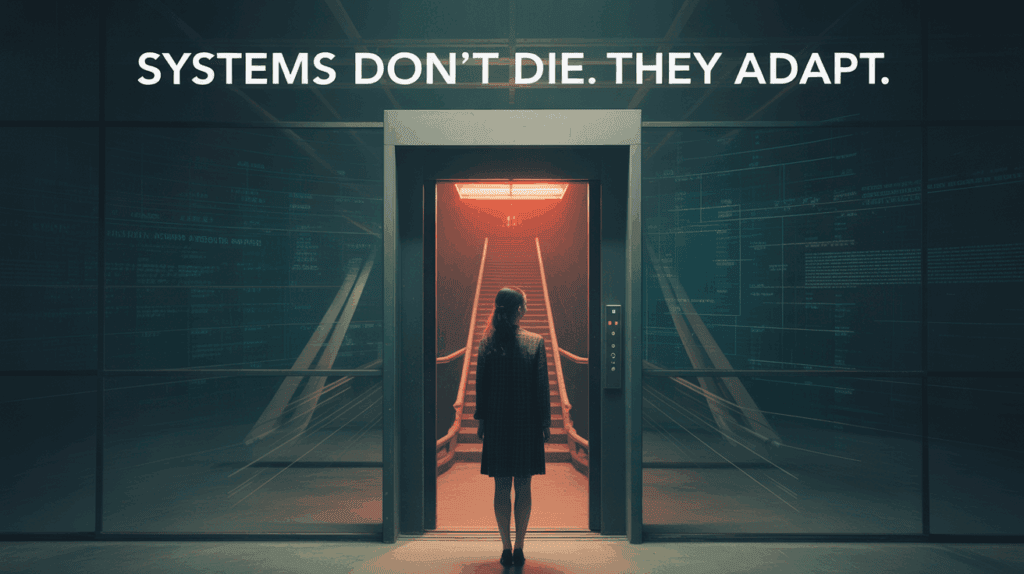
Lately, I’ve been thinking about what happens after we expose the truth.
When the villains fall, when the systems crumble — what do we do next?
That’s the question that followed me after finishing The Thirteenth Button. I thought Maya’s story was over. She had escaped the building, survived the nightmare, exposed the truth.
But stories about power don’t end when you reveal them. They adapt. They heal. Sometimes, they come back smarter.
That realization became the heart of the second book in The Hidden Floors series:
The Fourteenth Floor: Where Systems Learn from Their Wounds
When Systems Heal Themselves Wrong
I’ve always been fascinated — and a little haunted — by how systems evolve after being exposed.
Governments, corporations, algorithms — they rarely die. They mutate. They take their failures as lessons. They learn the language of reform, and they use it to hide in plain sight.
That’s the world Maya walks into in The Fourteenth Floor.
She’s no longer the terrified nurse trapped in someone else’s nightmare. She’s the woman invited back to rebuild it — and to decide what “better” really means.
The horror isn’t physical anymore; it’s ethical. The tension doesn’t come from what’s hidden, but from what we see clearly and still decide to live with.
Writing the Descent
I wanted this book to feel quieter — but heavier.
The Thirteenth Button was panic and revelation. The Fourteenth Floor is aftermath and consequence.
Instead of running through corridors, Maya sits in boardrooms. Instead of fighting monsters, she meets people who believe they’re saving the world — and maybe they are. The deeper she goes, the harder it becomes to tell reform from control, protection from manipulation.
The “floors” this time aren’t made of concrete. They’re made of choices.
Each level down brings another layer of compromise.
Each reform hides a cost.
And at the bottom of it all is the question: Can you fix something without becoming part of it?
The Emotional Core
Maya’s evolution mirrors what so many of us experience in the real world: you start as an idealist, then life hands you nuance.
You fight a system, and then you realize it’s inside you.
There’s a line in the book that became its heartbeat:
“Maybe systems don’t die. Maybe they just learn better lies.”
That’s what The Fourteenth Floor is about — not cynicism, but survival. How we learn to live inside imperfect structures, and how we carry the moral fatigue of knowing we can’t save everyone.
But also, how we keep trying anyway.
Because progress isn’t purity. It’s persistence.
Looking Ahead: The Architect
Every floor hides another.
The next book in the series — The Architect — begins five years later. Maya is older, calmer, and perhaps more dangerous in her calmness. She’s asked to lead the very network she once exposed.
This time, the question isn’t how to tear the system down, but how to end it — permanently — and whether she has the right to decide when that happens.
If The Thirteenth Button was about survival, and The Fourteenth Floor about compromise,
then The Architect will be about legacy — and learning when to stop building.
Because even systems that learn must one day be dismantled.
Where to Begin
If you’re new to The Hidden Floors series, start with The Thirteenth Button — the origin of Maya’s descent into the underworld of human systems.
Then follow her into The Fourteenth Floor: Where Systems Learn from Their Wounds — a psychological thriller about reform, responsibility, and the price of progress.
And stay tuned for The Architect, the final chapter, arriving soon.
Because some structures collapse.
Others evolve.
And some — if you’re brave enough to descend — teach you how to rebuild the world from its ruins.
Author’s Note
I write stories about systems — the ones we build, the ones that break us, and the ones we quietly maintain because we’re too tired to start over.
The Fourteenth Floor came from that exhaustion — the realization that sometimes reform and surrender look almost the same.
But maybe they’re not. Maybe the smallest act of resistance is to keep thinking, to keep feeling, to keep asking whether “better” is really good enough.
If this book leaves you uneasy, reflective, or quietly hopeful — then it did what it was meant to.
— Brian A. Clark
Author of The Hidden Floors series